Is HIFU better than a traditional face lift? The answer depends on what “better” means: less downtime, stronger lifting, lower cost, or longer-lasting change. High-intensity focused ultrasound (HIFU) uses focused energy to heat targeted tissue beneath the skin. A traditional facelift is surgery, typically involving incisions and repositioning of facial tissues. These treatments address different needs.
The American Society of Plastic Surgeons reported 78,482 facelift procedures in the United States in 2023. That figure shows continued demand for surgical facial rejuvenation, but it does not prove that surgery is right for every patient. The U.S. Food and Drug Administration has cleared the Ultherapy system for specific lifting indications, including the brow, neck, and under-chin area. Clearance applies to that device and its stated uses; it should not be treated as proof that every HIFU device produces the same results.
The practical difference is visible in the recovery room. HIFU is generally performed without surgical incisions, though temporary tenderness, redness, or swelling can occur. A facelift involves surgery, anesthesia, and a longer recovery, but may offer more substantial correction for pronounced sagging. Evidence and outcomes vary by device, practitioner, skin condition, and treatment goals. Not a perfect comparison.
This guide examines results, risks, recovery, and durability. It also considers who may benefit from each option. HIFU can be appealing when downtime matters, but it is not a non-surgical facelift equivalent. A qualified medical professional can assess candidacy and explain realistic expectations. The distinction is easy to overlook.
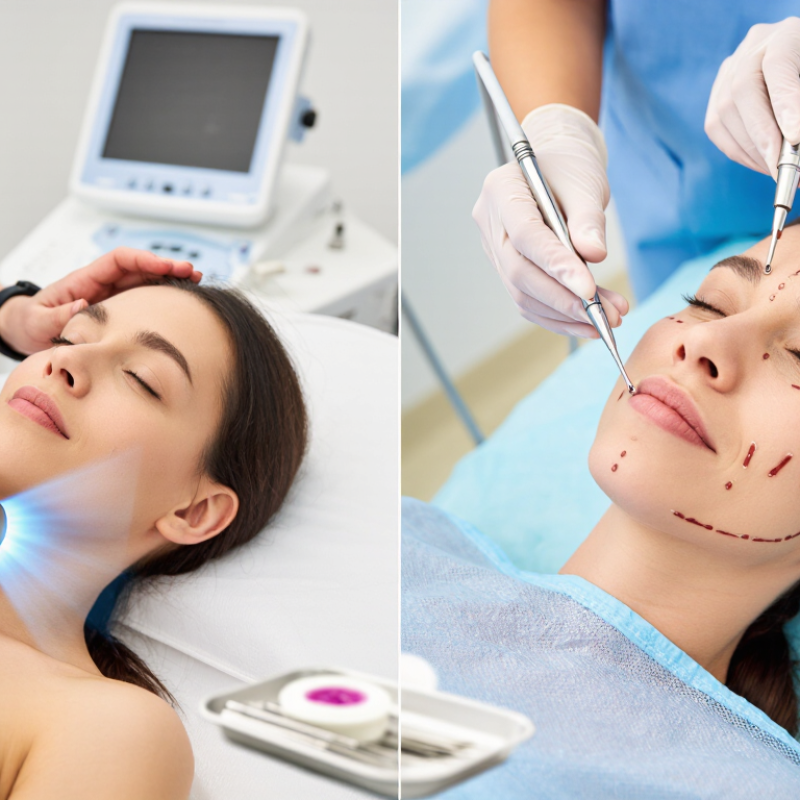
How HIFU Works: Focused Ultrasound Targets Tissue at Depths up to 4.5 mm
HIFU works by delivering focused ultrasound energy beneath the skin, rather than removing or repositioning tissue surgically. At selected depths, including 4.5 mm, the energy creates small thermal treatment points. These can stimulate collagen remodeling in deeper support layers. The 4.5 mm setting is a target depth, not a guarantee that every face has identical anatomy. Skin thickness varies. Treatment planning matters.
A 2010 peer-reviewed study in Archives of Dermatology followed 35 adults after focused-ultrasound treatment. At 90 days, blinded reviewers rated 86% as having improved brow lift, though results were generally modest. That distinction matters: HIFU may offer gradual tightening, while a traditional facelift physically lifts and repositions tissue. They are not equivalent procedures. The American Society for Dermatologic Surgery also notes that ultrasound-based treatments are noninvasive options, with outcomes and suitability varying by patient. Expect change over weeks or months, not an instant surgical lift. A small limitation: published studies often involve selected patients and specific devices, so their results may not predict an individual outcome. Skin can feel tender afterward. A qualified clinician should assess anatomy, expectations, and risks before treatment.
Why Is HIFU Better Than a Traditional Facelift? - How HIFU Works: Focused Ultrasound Targets Tissue at Depths up to 4.5 mm
| Comparison |
HIFU (Microfocused Ultrasound) |
Traditional Facelift Surgery |
| How it works |
Focused ultrasound creates small thermal treatment points beneath the skin, stimulating a wound-healing response and collagen remodeling. |
A surgeon repositions and, when appropriate, removes tissue; incisions and techniques vary by procedure and patient. |
| Treatment depth |
Some devices use focal depths up to about 4.5 mm. Actual depth and tissue reached depend on the device, treatment cartridge, anatomy, and settings. |
The surgeon works directly with selected skin and deeper tissues; the operative plane depends on the surgical plan. |
| Typical outcome |
May produce gradual, usually modest improvement in skin laxity. Results vary, and it does not remove excess skin. |
Can produce more substantial correction of facial and neck laxity for suitable candidates, though results and longevity vary. |
| Downtime |
Usually involves little to no planned downtime, but temporary tenderness, redness, swelling, or bruising can occur. |
Requires recovery from surgery; swelling and bruising are common, and return to normal activities varies by patient and procedure. |
| Risks and limitations |
Possible effects include pain, temporary altered sensation, bruising, or, rarely, burns or nerve effects. It may not suit significant skin laxity. |
As with surgery, risks can include bleeding, infection, scarring, anesthesia complications, and nerve injury; individual risk varies. |
| Best understood as |
A nonsurgical option for selected people seeking subtle tightening and willing to accept variable results. |
A surgical option for people seeking a more pronounced lift who are appropriate candidates for an operation. |
HIFU is not universally better than a facelift: the appropriate choice depends on treatment goals, anatomy, health, and tolerance for downtime and risk. Consult a qualified medical professional for individualized advice.
What FDA Clearance Covers: Ultherapy’s Cleared Lifting Areas and Intended Uses
Why Is HIFU Better Than a Traditional Facelift?
FDA clearance for focused ultrasound lifting is specific, not a blanket promise to lift every part of the face. The cleared uses cover lifting the eyebrow, skin beneath the chin and on the neck, plus improvement of lines and wrinkles on the décolletage. The FDA’s device documentation defines these intended uses; it does not establish that treatment matches surgery or works equally well for every patient. Small details matter. A clinician should explain which area is being treated, what change is realistic, and what risks apply to your skin and health history.
The difference is practical. Ultrasound delivers energy beneath the skin without an incision, while a facelift surgically repositions tissue. That may mean less downtime, but results are typically more modest and may vary. The American Society of Plastic Surgeons reported Face Lift procedures among its top cosmetic surgical procedures in its 2023 statistics, reflecting continued demand for surgical options—not proof that one method is better. Ask to see the exact cleared indication and discuss alternatives with a qualified clinician. Even a precise treatment plan cannot promise a precise result.
How HIFU Results Compare: Clinical Studies Track Outcomes for Up to 12 Months
HIFU is not simply a better facelift; it is a less invasive option for a different degree of skin laxity. Clinical studies of focused ultrasound commonly assess results over several months, with some follow-up extending to 12 months. They generally measure changes in skin tightness, facial photographs, and patient satisfaction—not surgical-level lifting. Small samples and varied treatment settings make results difficult to compare. That matters.
A 12-month result should be read as a time point, not a promise that lifting will last a year for every patient. Published studies report gradual, usually modest improvement, while swelling, tenderness, or temporary numbness can occur. Outcomes also depend on age, skin quality, treatment depth, and the clinician’s technique. Researchers do not yet have strong, large-scale head-to-head trials showing HIFU matches a traditional facelift. For pronounced sagging, surgery can reposition tissue more substantially; HIFU may suit people seeking subtler change and minimal downtime.
The American Society of Plastic Surgeons’ 2023 procedural statistics recorded 78,482 facelift procedures in the United States, showing continued demand for surgical lifting, but not proving one approach works better. Before treatment, ask what the clinic measures and when it will reassess you. A clear baseline photo helps. So does an honest discussion of uncertainty.
Treatment and Recovery: Non-Surgical HIFU Versus Facelift Surgery
HIFU and facelift surgery involve very different treatment and recovery experiences. HIFU uses focused ultrasound energy to heat targeted tissue beneath the skin. A session usually requires no incisions or general anesthesia, though sensations can range from warmth to brief, sharp discomfort. Some people notice mild redness, tenderness, or swelling afterward. These effects often settle within days, but individual responses vary.
The changes develop gradually as the body produces collagen, so results may take several months to become noticeable. They are usually more subtle than the lift surgery can provide, and they may not meet the needs of someone with significant loose skin. Recovery is usually lighter. Still, it is not effortless. A practitioner should review medical history, skin concerns, and realistic expectations before treatment.
A traditional facelift involves surgery, incisions, and recovery from anesthesia. Bruising, swelling, tightness, and visible scars near incision sites can occur, with healing often taking weeks. Surgical results may be more pronounced, but surgery carries greater risks and requires careful follow-up. Neither option suits everyone. Choosing between them depends on health, anatomy, desired change, and willingness to accept downtime; a qualified clinician can explain the likely benefits and limitations for an individual case.
Risks and Candidate Suitability: What Clinical Evidence Says About Each Option
Clinical evidence suggests that high-intensity focused ultrasound (HIFU) can produce modest, gradual tightening in some people with mild skin laxity. It avoids incisions and general anesthesia, but treatment may cause temporary redness, tenderness, swelling, or bruising. Less commonly, patients report numbness, burns, or nerve-related symptoms. Results vary with device settings, anatomy, and practitioner skill. The evidence is still less extensive than the evidence supporting surgical facelifts, and improvement is not guaranteed.
A traditional facelift involves surgery, so risks can include bleeding, infection, scarring, anesthesia complications, and changes in sensation. Recovery usually takes longer, but surgery can address more pronounced sagging and often creates a larger, longer-lasting change. It is not suitable for everyone. A qualified clinician should review medical history, medications, skin condition, and expectations before either option. HIFU may suit someone seeking subtle improvement without surgery; a facelift may be considered when laxity is substantial and health permits an operation. Neither is risk-free. And neither stops aging. A careful consultation matters, though even that cannot predict every outcome.
HIFU vs. Traditional Facelift: Typical Recovery Time
These ranges are approximate and vary by treatment, individual healing, and what is counted as recovery. HIFU is non-surgical and generally involves little downtime, but may cause temporary pain, swelling, redness, or numbness; rare complications can include burns or nerve effects. A facelift typically offers a more substantial surgical lift, with risks such as bleeding, infection, scarring, and anesthesia complications, plus a longer recovery. HIFU may suit people with mild laxity seeking a modest change; surgery may be considered for more pronounced laxity. Suitability requires assessment by a qualified clinician.
Conclusion
Is HIFU better than a traditional face lift? The answer depends on your goals, skin laxity, health, and willingness to undergo surgery. High-intensity focused ultrasound delivers energy to tissue at selected depths, including depths of up to 4.5 mm, to encourage gradual lifting and tightening. Its cleared uses apply to specific treatment areas and intended purposes, so results should not be assumed to cover every concern. Clinical studies have followed outcomes for as long as 12 months, though the degree and duration of improvement can vary.
Unlike facelift surgery, HIFU is nonsurgical and generally involves less recovery time, but its effects are typically more modest and may develop gradually. Surgery can provide a more substantial change for suitable candidates, with greater recovery demands and surgical risks. Both options have potential side effects, and suitability depends on individual circumstances. A qualified clinician can explain the evidence, assess risks, and help determine which approach better matches a person’s expectations.

 Aesthe Medical